
What Is ESG Investing And Why Is It Important?


Recent years have seen significant growth in the adoption of ESG investing, driven by a growing recognition of the important role that sustainable development plays in shaping the future of our world. As people move toward more sustainable and socially responsible behaviors in their daily lives, they are revising their financial strategies accordingly. By investing in companies with high ESG scores, they join a broader movement to address environmental, social and governance issues and support businesses that prioritize sustainable development.
In this article, we'll look at the basics of ESG investing, why it's important, and the current challenges surrounding such investments.
What is ESG investing?
ESG investing refers to investment dynamics that focus on achieving effective environmental, social and governance outcomes . In other words, it's about investing in companies that rank high on the scale of social and environmental responsibility, as determined by some independent research groups.
By investing in ESG, investors ensure that they are investing their assets in companies with sustainable infrastructure. It's about partnering with organizations that are committed to implementing practices that can make the world a better place.
What are the criteria for evaluating companies for ESG investing?
ESG criteria give investors a broader view of a company's future prospects and reputation. By analyzing this, investors can make more informed decisions, identify red flags and seize opportunities.
This involves evaluating the company based on the following three factors:
- Environment: The first pillar of ESG investing, environment, covers a company's impact on the environment. Under this umbrella, investors primarily analyze a company's carbon footprint, including direct emissions, emissions from energy use, and emissions in the supply chain. Other environmental factors considered by investors range from evaluating a company's management of waste and toxic chemicals to other sustainability efforts throughout the supply chain.
- Social: Next comes the "social" component of ESG investing, which defines a company's approach to its employees and how its operations impact society as a whole. From a social perspective, investors look at a company's practices related to racial diversity, hiring, labor standards and human rights.
- Governance: The governance aspect of ESG is concerned with determining the quality of a company's management and control system. Investors assess whether a firm has strong and accountable leadership, strong audit programs, dispute resolution capabilities, and a fair compensation infrastructure, among other such efforts. In general, to qualify for ESG, a company must promote “good governance”.
Why should you consider ESG investing?
ESG investing has become an excellent choice for investors who want to play their part in mitigating the challenges facing our planet, including the climate crisis, social injustice, racial or gender inequality and cyber security issues.
By investing in companies with high ESG scores, you can ensure that your financial management does not conflict with your ethical principles. At this point, it is important to dispel the misconception that ESG investments must "pay" a high return on investment. It is actually possible to achieve high financial performance by investing in companies that do not exacerbate environmental and social problems. Ultimately , ESG investing is a win-win situation for both your financial goals and the world.
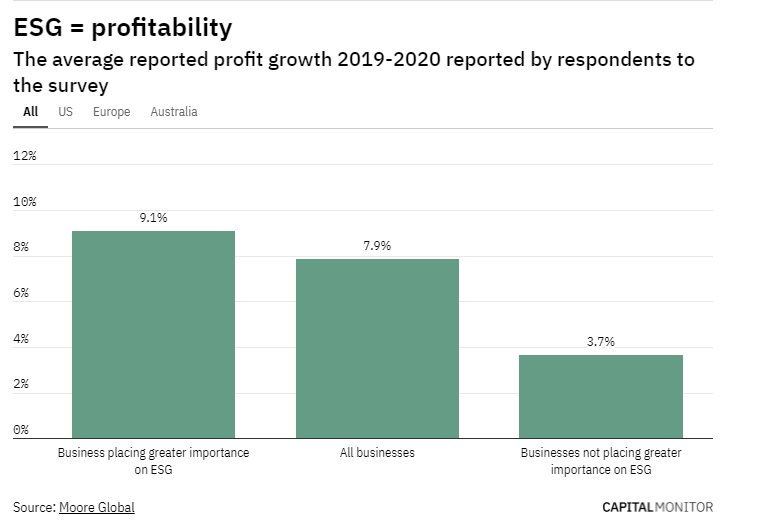
According to Moore Global, over the past 3 years, companies that prioritize ESG factors have seen a significant 9.1% return and 9.7% revenue growth. In addition, about 84% of these companies reported at least a "slight" improvement in their ability to raise capital. Interestingly, the IT and financial sectors lead the way in adopting ESG practices, while the public sector lags behind.
Additionally, Morningstar notes that global ESG fund assets will reach approximately $2.5 trillion by the end of 2022, up from $2.24 trillion in the third quarter of the same year. Amazingly, this jump in assets of around 12% is almost twice the growth of global stock markets worldwide.
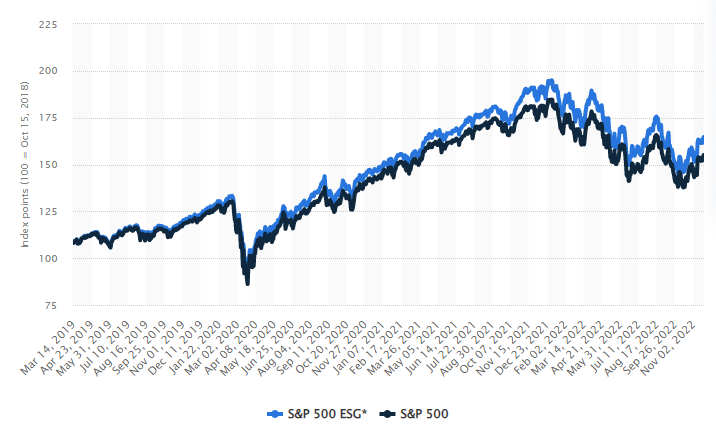
From an investment perspective, ESG products can offer significantly higher returns, although investments are never guaranteed. Let's compare the performance of the S&P 500 and the S&P 500 ESG Index from March 2019 to November 2022.
According to Statista, both indicators were relatively good in 2019; However, through the end of 2020, the S&P 500 ESG consistently outperformed the S&P 500 by an average of four points. The main difference between the two indices was that the S&P 500 ESG index had and has had a higher concentration of technology securities. Compared to companies with high environmental, social and governance (ESG) performance.
ESG investment issues
Investors are generally most concerned about how their adoption of ESG investment strategies will affect their investment returns. In addition to performance issues, the lack of transparent and up-to-date information is also a barrier to their decision to start investing in ESG. In addition to these two main problems, investors may face some other significant problems:
- Concerns about greenwashing
- Lack of appropriate ESG strategies and products
- Complex regulatory landscape
Regarding investment returns, the Kenan Research Institute also explains that the returns associated with ESG ratings are not certain . While some studies show that companies with high ESG ratings outperform stocks, others show no significant effect and in some cases even report lower financial returns.
the last row
There is no doubt that sustainable practices are important for a better future, and investing in ESG is a great way to make a difference in this regard. To be part of the ESG investment wave, you may want to consider investing in ESG stocks and ETFs or seek the help of financial advisors to determine what is best for you. However, you should always choose a diversified portfolio with different categories or categories of investments to spread your risk and maintain a competitive edge.
Read more:
https://thetradingbay.com/active-vs-passive-investing-weighing-the-risks-and-rewards/