
What Is The Dow Jones Index? Why Is It So Popular Among Wall Street Investors?

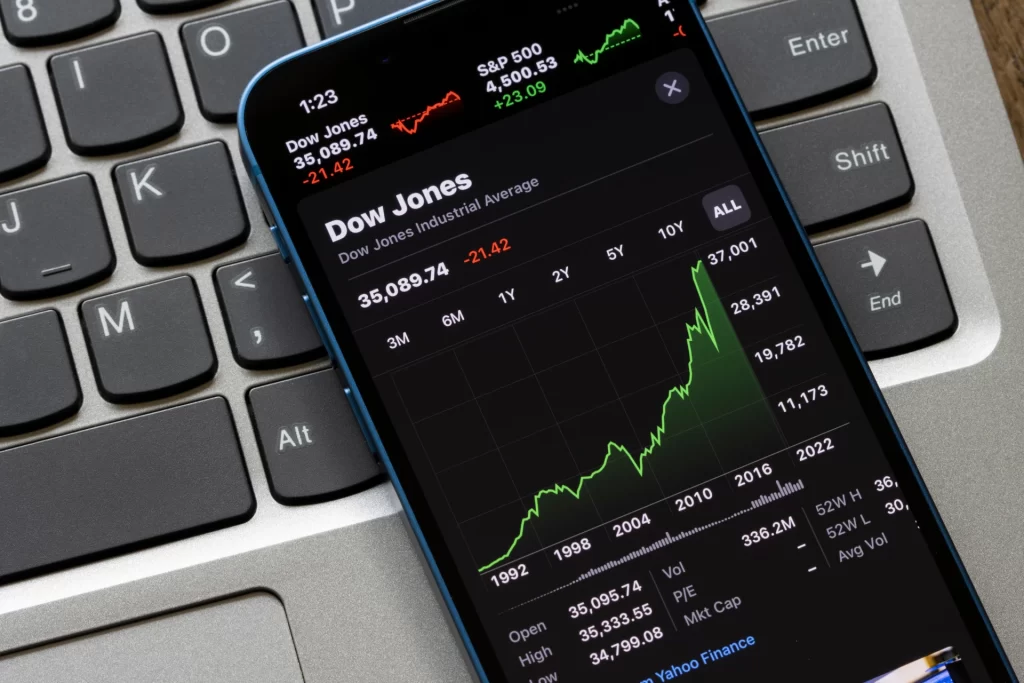
The Dow Jones Index, also known as the Dow Jones Industrial Average or US30, is one of the most popular and well-known stock market indices along with the NASDAQ and the S&P 500. Although there are over 5,000 indices that make up the US index. stock market, market leaders such as the Dow Jones are considered the benchmark for the performance of the entire stock market.
Here's everything you need to know about this widely known stock market index.
What is the Dow Jones Industrial Average (DIJA)?
The Dow Jones Industrial Average (DIJA) is a stock market index that tracks the 30 largest US companies whose stocks are publicly traded on the NYSE and Nasdaq stock exchanges. The index was created in 1896 by Charles Dow and his colleague Edward Jones because they believed it would serve as an indicator of the health of the US economy as a whole.
More than 55% of the weight of the Dow Jones index is represented by companies belonging to three sectors - health care, information technology and financials. While the rest of the mass is represented by various industries, including energy, industrial enterprises, raw materials and consumer goods, services and communication materials.
Additionally, Dow Jones is operated by S&P Dow Jones Indices , a joint venture between S&P Global, CME Group, and News Corp, but is primarily controlled by financial analyst firm S&P Global.
Understanding the Dow Jones: how does it work and how are the prices calculated?
While most stock indices are weighted by market capitalization, the Dow Jones Industrial Average is a price-weighted index, which means that its value is determined by the price of each stock included in the index. Simply put, the value of the Dow Jones is determined by the average price of 30 companies included in the index. However, the Dow Jones is not calculated using a simple arithmetic average due to many complex aspects such as mergers, splits, and stock splits, among other events.
Therefore, a special "Dow Jones divisor" is used to obtain the average, which is a predetermined constant that shows the effect of a one-point price movement in any of the 30 Dow Jones stocks. In other words, it is the denominator by which the sum of the prices of 30 stocks is divided to calculate the price or value of the entire Dow Jones index.
The Dow Jones Divisor is also sometimes converted to a reference value of $30 - in October 2022 the Dow Jones Divisor has a value of 0.1517.
However, here is the DIJA price calculation formula. As mentioned earlier, you can calculate the value of this index by adding the stock prices of the 30 companies listed in the Dow Jones index and dividing by 0.1517.
DJIA price = sum of prices of all components / Dow divisor
A change in any Dow Jones stock by one point will change the value of the index by the same number of points. Note, however, that the movement of the most expensive stocks has the greatest impact on the price of the index in percentage terms.
To better understand how this weighted price adjustment works, let's look at a small example.
On November 15, 2022, Dow INTC's low stock price was $30.8, while UNH's high was $519.7. Now, following the price move , Intel stock would need to rise almost 16.9% to have the same impact on the Dow Jones that UnitedHealth could have with a price change of just 1%.

A brief history of the Dow Jones
The Dow Jones was the second oldest US stock market index, comprising only 12 companies, mostly from the industrial sector, when it was launched in 1896. During this period, industrial companies such as sugar, tobacco, cotton and oil mainly constituted the economy as a whole.
However, the composition of the index changed over time, and in 1928 it expanded to 30 companies. Over time, many Dow Jones stocks have been removed and replaced based on changing financial dynamics. Note that the 30 large-cap stocks of the Dow Jones were selected subjectively by the editors of the Wall Street Journal.
Dow Jones companies
Below is an updated list of companies included in the Dow Jones Index for 2022.
| Company | lester |
| 1. Mixed Health Group | 10.85% |
| 2. Goldman Sachs Group | 6.68% |
| 3. Home Depot Inc. | 6.15% |
| 4.Microsoft Corporation. | 5.67% |
| 5. McDonald's Corporation. | 5.26% |
| 6. Amgen Inc. | 4.96% |
| 7.Visa Inc. | 4.18% |
| 8.Honeywell International Inc. | 3.84% |
| 9 Salesforce Inc. | 3.80% |
| 10.Caterpillar, Inc. | 3.67% |
| 11. Johnson & Johnson | 3.50% |
| 12. Boeing Company | 3.34% |
| 13 Apple Inc. | 3.33% |
| 14. Travel Company Inc. | 3.17% |
| 15. American Express Company | 3.12% |
| 16. Chevron Corporation | 3.11% |
| 17. Procter & Gamble | 2.90% |
| 18. 3M Company | 2.88% |
| 19. International Commercial Machinery Society | 2.65% |
| 20.Walmart Inc. | 2.62% |
| 21.NIKE Inc. | 2.29% |
| 22. JP Morgan Chase & Co. | 2.28% |
| 23. The Walt Disney Company | 2.18% |
| 24. Merck & Co. | 1.75% |
| 25. The Coca-Cola Company | 1.28% |
| 26. Dow Inc. | 1.03% |
| 27. Cisco System Inc. | 0.91% |
| 28. Verizon Inc. | 0.91% |
| 29. Walgreens Boot Alliance | 0.78% |
| 30. Intel Corporation. | 0.73% |
How to invest in the Dow Jones?
Although you cannot immediately invest in the Dow Jones, there are three ways to benefit from the index.
- Invest in exchange-traded funds that track the performance of the Dow Jones Index, such as the SPDR Dow Jones Industrial Average ETF. This is the easiest and most convenient way to capitalize on this index, with the ETF provider automatically adjusting funds to reflect changes in the Dow Jones.
- Buy individual stocks of all US30 companies. In this case, you have to manage 30 promotions and edit or manage them yourself.
- You can also invest in Dow Jones derivatives such as options and futures. CBOE Global Markets currently offers options contracts on Dow Jones and CME Group allows investors to purchase futures contracts on Dow Jones.
Read more:
https://thetradingbay.com/etfs-vs-stocks-what-one-is-best/
https://thetradingbay.com/what-is-dollar-cost-a-average-dca-how-to-build-your-wealth-with-this-technique/