
Is Cryptocurrency Legal In Russia Or Russia Bans Crypto?

In Russia, cryptocurrencies are steadily increasing as the Russian government continues to evaluate its rules and laws regarding digital assets which will take effect soon. Recently, Russia has made several cryptographic measures that allow the use of cryptocurrencies in cross-border transactions.
In September 2022, the Bank of Russia and the country's Ministry of Finance announced that they had reached an agreement allowing cross-border payments in cryptocurrencies. In addition, Russian government officials said in a Reuters article that they would “sooner or later legalize cryptocurrency as a means of payment.” Such a policy appears to be working as two of Russia's main financial institutions have also reportedly agreed to allow the use of crypto payments in international trade.
This comes at a time when Russia is struggling with sanctions. Sanctions are restrictions imposed by a country on another country to prevent it from violating international law. Western countries have imposed broader sanctions on Russia, targeting major state-controlled and state-owned banks, individuals, companies and industries.
Russia's central bank assets were frozen to prevent the country from accessing its $630 billion foreign exchange reserves. The Treasury Department has rejected the central bank's call for a complete ban on cryptocurrencies.
Russian citizens have turned to crypto because in most cases it remains one of the few financial instruments available. After the withdrawal of Visa and Mastercard from the Russian market and the separation of some banks from SWIFT, cryptocurrencies, especially the stablecoin USDT, have become one of the most popular ways to transfer money abroad. The government doesn't seem to mind, and the endorsement of the asset class appears to have broad support within the Russian government.
Will Russia Ban Crypto After EU Ban?
Contrary to the actions of the Russian government, the European Union has just confirmed a complete ban on providing crypto services to Russia and tightened sanctions.
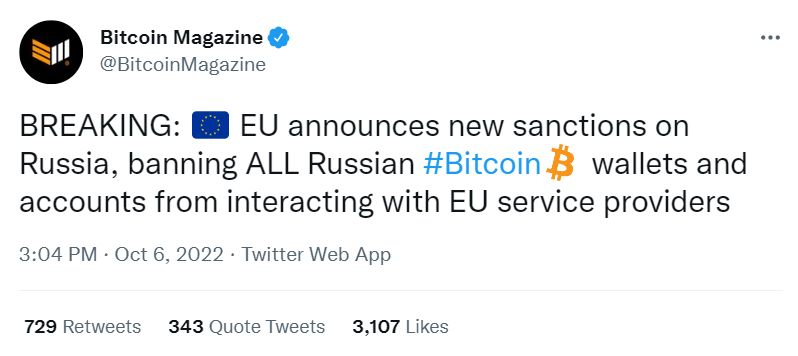
The bloc imposed an eighth package of economic and political measures against Russia following its invasion of Ukraine in February, tightening previous rules that limited cryptocurrency payments to European wallets at €10,000 ($9,900).
“The existing ban on crypto assets has been strengthened by banning any crypto asset wallet, account or storage service, regardless of wallet size,” the European Commission said in a statement on Thursday, after last week's proposal was approved by the EU. Government. The new EU cryptocurrency ban prohibits services offered by European cryptocurrency providers to Russian residents and entities unless they are on the block.
However, Anatoly Aksakov, chairman of the State Duma Committee on Financial Markets, argues that this will only encourage Russia to develop its own blockchain technology. At the same time, he noted that modern technology allows Russia to bypass these restrictions.
“Similar sanctions have already been applied. They closed their official crypto exchange office in Russia, but actually that doesn't change anything. People can use virtual offices and it doesn't matter if they are in Russia, China or America," said the chairman of the committee. Aksakov is sure that next year will be the year of digital financial investment in Russia.
Crypto Ban in EU: Its Impact on Russian Citizens
The measures introduced by the European Union could effectively prevent Russian citizens from using cryptocurrency wallets on major cryptocurrency exchanges such as Binance or Coinbase.
In March 2022, transaction volume for the ruble-USDT pair surpassed the equivalent of $30 million, although previously it was mostly in the $5 million or less range. Russia is actively using the largest cryptocurrency exchange Binance and its peer-to-peer service. In addition, many crypto exchanges are located outside the EU and a large number of crypto wallets are still anonymous.
Even under EU sanctions, Russian users can still use decentralized exchanges that have no central intermediary between buyers and sellers and trade crypto assets through smart contracts. The exchange does not track transactions between its users, nor does it store their customers' funds or passwords in their cryptocurrency wallets. And because these exchanges do not hold customer funds, they are not popular with hackers. These exchanges often do not comply with state finance laws, so decentralized exchanges do not impose restrictions on Russian clients.
While most major exchanges are subject to the new EU ban, Russian traders can turn to crypto exchanges such as FTX, Huobi, and Bybit. This leaves a lot of room for Russian crypto enthusiasts who own a lot of popular cryptocurrencies.
How Many Cryptocurrencies Do Russians Have?
By early 2022, the Kremlin estimated that Russia had digital assets worth about 10 trillion rubles ($124 billion). Bloomberg provides another number. According to Bloomberg, Russia owns 16.5 trillion rubles ($214 billion), or about 12% of all cryptocurrency assets worldwide.
Among the 14.6 million Russians who own cryptocurrency, Ethereum is the most popular digital asset, with 32% of Russian cryptocurrency holders owning the currency. Surprisingly, Bitcoin is less popular in Russia, with Bitcoin in second place with 30.8%. The fast-growing altcoin market in Russia is reflected in their holdings data, as nearly one in five cryptocurrency holders in Russia likely owns Ripple, Dogecoin or Solana. Russia is also one of the few countries where women own more cryptocurrency than men.
The state of cryptocurrencies in Russia.
Earlier this year, the Bank of Russia announced that it is actively working on the development of digital financial instruments. The digital ruble and digital financial asset (DFA) are the main tools for the development of the digital economy. At the same time, the Bank of Russia and the Ministry of Finance agreed on a position to regulate cryptocurrency mining. According to Anatoly Aksakov, mining should only be allowed in areas with a shortage of energy. At the same time, cryptocurrency mining in low-energy areas should be prohibited.
Along with these innovations, the Ministry of Finance, Rosfinmonitoring and the Central Bank of Russia are actively working to regulate the issuance, circulation and operation of digital currencies for settlement with other countries. The current version of the bill affects not only local infrastructure for cryptocurrency trading, but additional mining rules as well. Apparently, the Russian government is looking for ways to encourage cross-border transactions.
Will the United States tighten cryptocurrency laws?
In response to this action of the Russian government, the US government took its own action. The cryptocurrency transparency law in Russia was passed by the House of Representatives and sent to the Senate, where it currently sits on the committee. The bill calls for the State Department to submit a report to Congress detailing how “cryptocurrencies or other technologies containing blockchain” will be used under the current draft to promote economic development and provide humanitarian assistance to Ukraine. He will also ask the Ministry of Finance and Ministry of Foreign Affairs to prepare reports on the impact of cryptocurrencies on the effectiveness and enforcement of sanctions against Russia.
Additionally, the Treasury Department warned that unregulated cryptocurrencies could pose a risk to the US financial system. The warning is part of the first major public report released by the Treasury Department's Financial Stability Oversight Board on digital assets.
"The report concludes that activities involving crypto assets may pose a risk to the stability of the US financial system and underscores the importance of proper regulation, including enforcement of existing laws," Treasury Secretary Janet Yellen said in a statement. "It is imperative that government actors work together to advance these recommendations."
In March 2022, President Sherrod Brown said, "It is now imperative that we strengthen our financial stability and national security. This includes protecting Americans from the risk cryptocurrencies pose to our economy and ensuring crypto is not used to evade the law.
Crypto Exchanges in Russia
At the moment, it seems that the new bans and rules do not affect the most popular Russian crypto exchanges, including crypto exchange aggregator BestChange. This site contains the most popular and reliable exchanges in Russia where citizens buy and withdraw cryptocurrencies. Some of them don't even require ID or KYC, and transactions are processed card to card, which is convenient for many cryptocurrency holders.
BestChange serves as a solid alternative to standalone platforms that can scam cryptocurrency holders out of their money. Most exchanges try to stay in the top 100 on this site because customers can influence their platform with positive or negative feedback and stop the exchange. Overall, the crypto space in Russia seems to be doing relatively well despite recent developments in the global crypto world.
Conclusion
The new actions by the US and EU governments aim to end the war, thereby dividing the global financial arena, which could have serious consequences for the decentralized world of cryptocurrencies. However, blockchain and cryptocurrencies at least offer innovative and even inspiring models of how systems can overcome and counter the forces of deglobalization. Essentially, they are a technical means of delivering services across borders, regardless of fluctuating political beliefs. Today, it is exciting and a little scary to watch the crypto landscape change and evolve.
Follow us on Medium, Twitter, Telegram, YouTube, and Reddit for the latest news on StealthEX.io and the rest of the crypto world.
Remember to do your own research before buying any cryptocurrency. The views and opinions expressed in this article are those of the author.
Cryptocurrency Cryptocurrency World Cryptocurrency Russia USDTPosts Is cryptocurrency legal in Russia or does Russia ban cryptocurrencies? appeared first on StealthEX.